
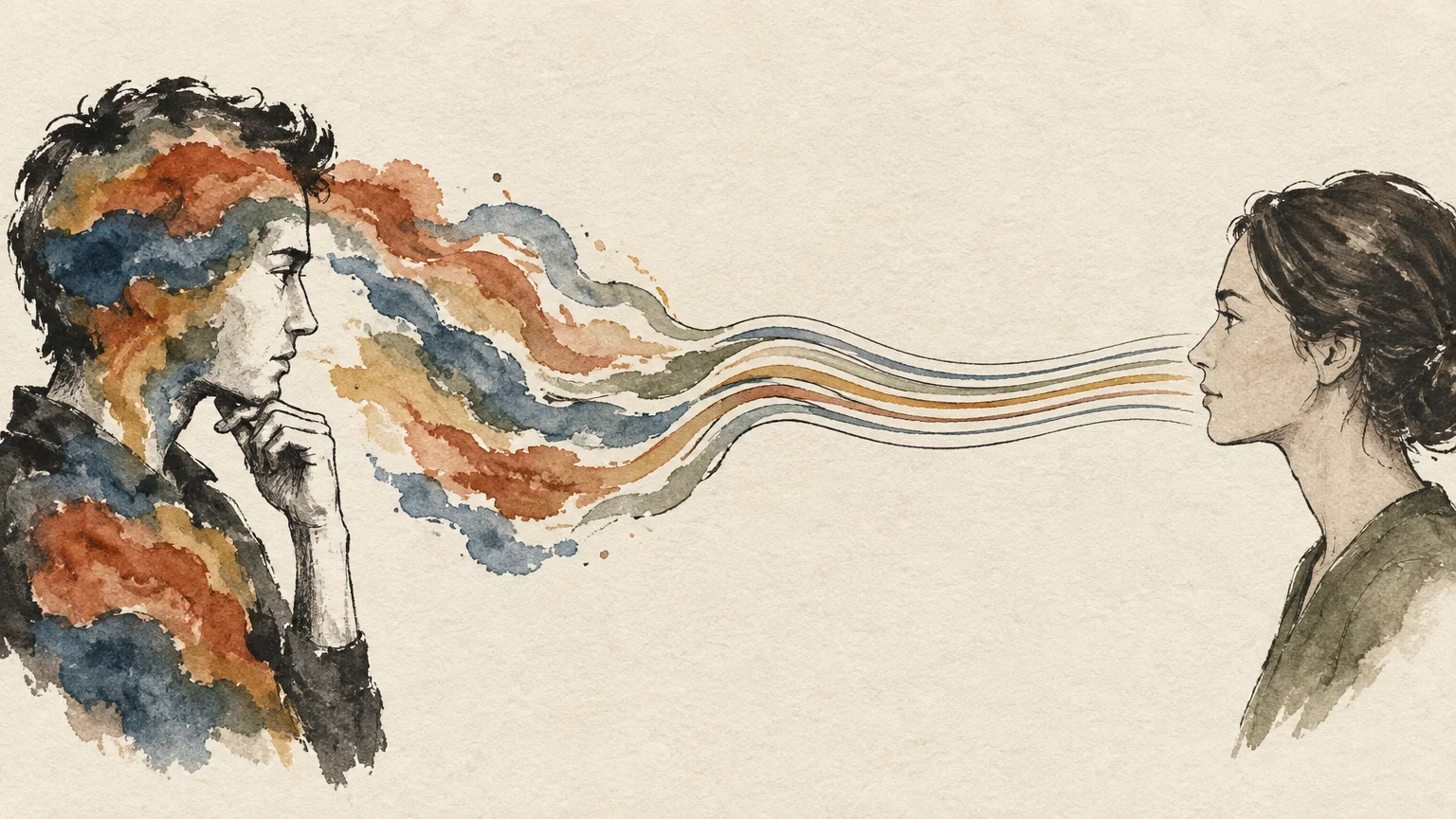
Emotional intelligence is the ability to notice, understand and manage emotions, both your own and other people’s. Research supports it as a real and learnable set of skills, linked with somewhat better relationships, wellbeing and performance in people-focused work.
What the research does not support is the popular claim that it matters more than IQ. How much it predicts depends heavily on how it is measured, and many self-report “EQ” tests overlap substantially with ordinary personality traits.
In this article
The original ability model and the popular version
Psychologists Peter Salovey and John Mayer introduced the scientific concept in 1990. Their later four-branch model describes perceiving emotions accurately, using emotions to help thinking, understanding what emotions signal, and managing emotions.
Daniel Goleman’s 1995 book Emotional Intelligence brought the idea to a mass audience. His five-component model is still the version most people encounter.
| Component | What it looks like under stress | One daily practice to build it |
|---|---|---|
| Self-awareness | Noticing “I’m getting defensive” during the conversation, not an hour later | Name your emotion precisely at two set points in the day |
| Self-regulation | Feeling the urge to snap back, then choosing a different reply | Take one slow breath before answering a message that irritates you |
| Internal motivation | Keeping going on a goal when progress is slow and no one is praising it | Write down one reason the task matters to you before starting it |
| Empathy | Asking what a colleague’s curt email might mean before assuming hostility | Ask one person a genuine question about how something felt for them |
| Social skills | Raising a disagreement directly without blaming or manipulating | Restate the other person’s point before making your own |
Self-awareness is the base the other four rest on. Goleman’s phrase “amygdala hijack” describes its opposite, when an intense emotion swamps deliberate judgment; it is a useful metaphor rather than a precise account of brain function.
Self-regulation is not suppression. Regulating an emotion means leaving enough space between feeling and acting to choose a response rather than being swept into an automatic one.
Empathy also differs from sympathy. Sympathy is feeling bad for someone; empathy is actively working out what they feel, without assuming their experience matches yours.
Goleman later condensed the model into four domains: self-awareness, self-management, social awareness and relationship management. Motivation folded into self-management and empathy into social awareness, so both versions describe much the same skills.
Ability tests and self-ratings give different answers
Researchers measure emotional intelligence in two quite different ways. Ability tests, such as the Mayer-Salovey-Caruso Emotional Intelligence Test (MSCEIT), set tasks with better and worse answers, like identifying the emotion in a face.
Self-report questionnaires ask people to rate themselves. They rely on the very self-awareness they aim to measure, and their scores overlap heavily with traits such as emotional stability, extraversion and conscientiousness.
The two kinds of score correlate only modestly. That gap is why Mayer, Salovey and Caruso argued that many popular measures blend a genuine ability with an assortment of unrelated traits.
Studies of job performance generally find that emotional intelligence adds a modest amount of prediction beyond IQ and personality. The added value shows up mostly in roles built on handling people and emotions, such as customer service, sales or management.
In highly technical or analytical work, general cognitive ability remains the stronger predictor. Claims that emotional intelligence explains most of success, or a fixed percentage of it, come from popular books rather than replicated studies.
The two are complementary, not competing, and a high IQ with weak emotional skills is entirely possible. That combination is one reason researchers study them as separate abilities.
Average sex differences appear on some measures, with women scoring slightly higher on empathy-related items in several studies. Variation within each group dwarfs the gap, and cultural rules about expressing emotion shape the results.
Not the same as agreeable or unemotional
Emotional intelligence is not the same as being agreeable. Someone who avoids every disagreement to keep the peace may be managing their own discomfort by avoidance; setting boundaries and disagreeing well are part of the skill.
It also does not mean feeling less. People with strong emotional skills feel anger, fear and sadness like anyone else; the difference lies in how they interpret and respond once the feeling arrives.
In conflict, self-regulation and empathy let people stay engaged instead of turning defensive or going silent. That is much of what arguing without damaging a relationship comes down to.
Long-term observational research on couples from the Gottman Institute points the same way. How partners respond to each other’s emotions during disagreement tracks closely with how their relationships fare.
Emotions shape decisions whether or not they are noticed. Someone who can say “part of this is frustration” can adjust for it; someone who cannot may believe they are being purely rational.
Difficulty regulating emotions is linked with higher rates of anxiety and depression, and the skills overlap with what therapies such as CBT and DBT teach. That is an association, not proof that emotional intelligence training prevents mental illness.
Children learn emotional skills largely by watching adults. Parents who name feelings and model calm regulation give children a working example to copy, which matters more than being told how to behave.
Goleman also applied the idea to leadership, arguing that a manager’s emotional tone spreads through a team. The argument is plausible, but much of the evidence relies on ratings from the same people, which makes effects easy to overstate.
Precise emotion words and other daily practice
Emotional skills do improve with practice, and studies of training programs generally report small to moderate gains. Many of those programs are short and measured by self-report, so long-term change is less well established.
Five practical starting points:
- Name the emotion precisely. Swap “stressed” or “fine” for frustrated, embarrassed, disappointed or envious; a precise label points toward what would actually help.
- Build in a pause. A breath, a few seconds or a short walk before replying gives deliberate thinking time to catch up with the first reaction.
- Ask instead of assuming. A question such as “What was going on for you when that happened?” builds empathy more reliably than guessing, because confident guesses are often wrong.
- Reflect back before replying. Summarizing what the other person said, a core part of active listening, shows whether you understood before you respond.
- Ask for feedback. A trusted friend, colleague or partner can describe how you come across under stress, surfacing blind spots that self-reflection misses.
Stress makes every one of these harder, which is why practical guides to building emotional intelligence often start with quick ways to bring stress down. A calmer body leaves more room for the other skills.
Working on all five components at once usually means little progress on any. Pick the clearest gap, whether naming feelings, reacting too fast or reading others, and practice that one for several weeks before adding another.
Treat slips as information rather than failure. A badly handled moment is a chance to review what happened and choose a different response next time.
Trouble naming feelings and other reasons to seek help
Everyone misreads people and loses their temper sometimes. A conversation with a doctor or therapist makes sense when emotional difficulties are persistent, cause real problems at work or home, or feel out of character.
Some people find it genuinely hard to identify or describe what they feel, a trait researchers call alexithymia. It is not a diagnosis in itself, but it is more common alongside depression, PTSD and autism, and therapy can help.
Feeling flat or cut off from emotions for weeks can be a sign of depression, and NIMH lists loss of interest or pleasure among its core symptoms. Persistent low mood deserves an assessment, not just more self-practice.
Emotional numbness has other causes too, including prolonged stress, trauma and some medications. A clinician can help sort out which applies.
Lifelong difficulty reading facial expressions, tone of voice or unwritten social rules, especially alongside sensory sensitivities or intense focused interests, can point to autism in adults, which often goes unrecognized until adulthood.
Frequent anger that feels out of proportion, or emotional swings that keep damaging relationships, are also worth raising. Therapies such as CBT and DBT teach regulation skills directly, with a structure and feedback that solo practice cannot fully replace.