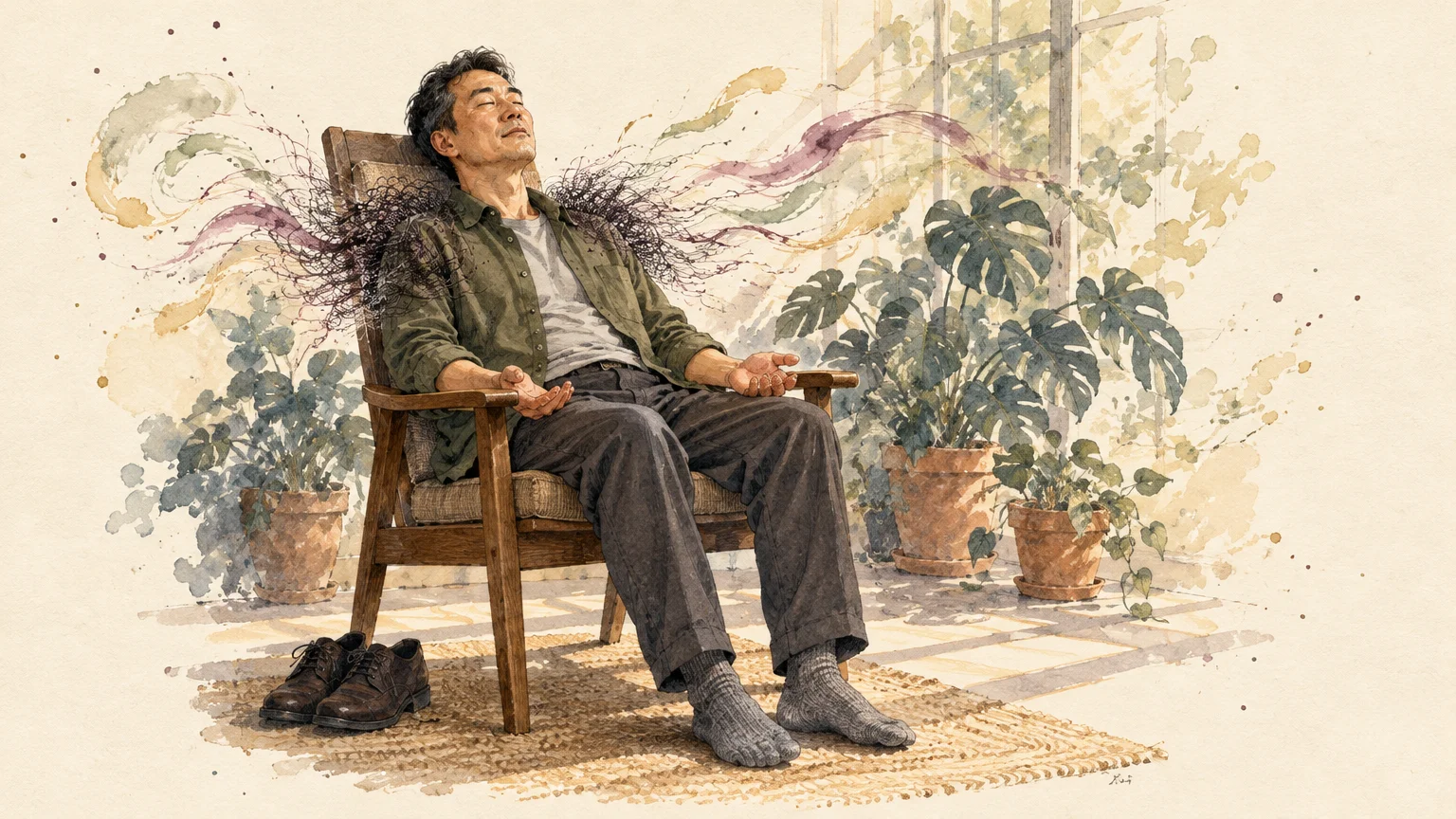
Tension has a way of hiding. Shoulders creep toward the ears during a long afternoon of emails, a jaw stays clenched through the evening, and nobody notices until a headache arrives or sleep will not come.
Progressive muscle relaxation (PMR) works on that tension from the body side: tense one muscle group on purpose, let it go, and notice the difference. The version most people learn today is a shortened descendant of a much longer method developed a century ago.
In this article
- Why tensing a muscle first makes letting go easier
- The full session, muscle group by muscle group
- Shorter versions as the skill builds
- A desk worker’s sore jaw and shoulders
- Practice problems from cramps to drifting off
- Cramps or soreness
- Pain, injury or recent surgery
- A wandering mind
- Feeling more anxious, not less
- Falling asleep or running out of time
- Solid support for anxiety, mostly in therapist-led form
Why tensing a muscle first makes letting go easier
Stress often shows up physically as muscle tension, headaches, a tight stomach and poor sleep. That physical tension can then feed the sense of being on edge, which keeps the loop turning.
The American physician Edmund Jacobson built his method on that link in the 1920s and 1930s, arguing that a deeply relaxed body is hard to combine with an anxious mind.
His original training covered dozens of small muscle groups and could take months of sessions to complete.
In 1973 the psychologists Douglas Bernstein and Thomas Borkovec published a manual that condensed the approach into 16 muscle groups, learned over a handful of sessions and then gradually shortened. Most modern scripts, recordings and therapist-taught versions come from their abbreviated sequence.
The tense-and-release contrast is what makes the skill learnable. Tightening a muscle deliberately makes the feeling of release easier to notice, and over weeks that sharper awareness lets people catch tension earlier and drop it without tensing first.
The full session, muscle group by muscle group
Set aside 15 to 20 minutes somewhere quiet. Sit in a supportive chair or lie on your back, loosen tight clothing, and close your eyes or rest them on one spot.
Three rules apply to every group. Tense at roughly half your maximum effort, keep breathing rather than holding your breath, and release all at once instead of easing off slowly.
In Bernstein and Borkovec’s protocol, each group is tensed for about 5 to 7 seconds, then relaxed for 30 to 40 seconds while you notice the change. Work through the groups in this order:
- Dominant hand and forearm: make a firm fist.
- Dominant upper arm: bend the elbow and tighten the biceps.
- Non-dominant hand and forearm: make a firm fist.
- Non-dominant upper arm: bend the elbow and tighten the biceps.
- Forehead: raise your eyebrows as high as they will go.
- Upper cheeks and nose: squint and wrinkle your nose.
- Lower face and jaw: clench your teeth lightly and pull back the corners of your mouth.
- Neck and throat: tuck your chin slightly toward your chest while gently resisting. Keep this one light.
- Chest, shoulders and upper back: draw your shoulder blades back and together.
- Abdomen: tighten your stomach as if bracing for a light push.
- Dominant thigh: tighten the muscles at the front and back of the thigh together.
- Dominant calf: pull your toes up toward your shin.
- Dominant foot: curl your toes gently downward.
- Non-dominant thigh: as for the dominant side.
- Non-dominant calf: pull your toes up toward your shin.
- Non-dominant foot: curl your toes gently downward.
Finish with a minute of stillness, scanning from head to feet and letting any leftover tightness go on an out-breath. Stand up slowly, since some people feel lightheaded after deep relaxation.
Relaxation techniques work best with regular practice, so a daily full session at a set time, such as after dinner, is the usual starting point. A guided recording helps while the order is still unfamiliar.
Shorter versions as the skill builds
Bernstein and Borkovec treat the 16-group session as a first stage. Once each group relaxes reliably, groups are combined, and eventually the tensing step is dropped altogether.
| Stage | What you do | Approximate time | Move on when |
|---|---|---|---|
| 16 groups | Tense and release each group separately | 15 to 20 minutes | Every group relaxes fully without repeats |
| 7 groups | Each arm as one unit; the whole face; neck and throat; chest, shoulders, back and abdomen together; each leg as one unit | About 10 minutes | Combined groups release as easily as single ones |
| 4 groups | Both arms and hands; face and neck; chest, shoulders, back and abdomen; both legs and feet | About 5 minutes | All four areas let go within a few breaths |
| Recall | No tensing; attend to each of the four areas and recall the feeling of release | 2 to 3 minutes | Relaxation comes without the tensing step |
| Counting or cue word | A slow count, or a word such as “relax” paired with an out-breath | Under a minute | Use it during stressful moments |
A week or two at each stage is a reasonable pace, though staying longer at the 16-group stage costs nothing. The final stage leans on a slow, steady out-breath, which can be practiced separately with the Calm Breathing Timer.
A desk worker’s sore jaw and shoulders
Picture someone with a desk job who notices, only on the drive home, that their shoulders ache and their jaw is sore.
They start with the 16-group session after dinner, using a recording for the first few evenings so they do not lose track of the order.
By the second week they notice the forehead and jaw take longest to let go, so they repeat those groups once each session. In week three they switch to seven groups, which fits before bed and sometimes ends with them asleep halfway through.
By week five they are using recall. Before a difficult meeting, they sit at the desk, bring attention to the four areas in turn and let each one soften; the meeting is no easier, but they walk in with lower shoulders and steadier breathing.
Because the evening session doubles as a wind-down, they log bedtimes and how rested they feel in the 30-Day Sleep Reset Tracker. That record shows whether the routine is helping sleep or simply feels pleasant.
Practice problems from cramps to drifting off
Cramps or soreness
The tension is usually too strong. Drop to about a third of maximum effort, especially for the feet, calves and neck, and skip any group that cramps.
Pain, injury or recent surgery
Skip any area that hurts, or use the recall stage for that part of the body. For people living with chronic pain, tightening sore muscles can increase pain, so very light tension or none at all is a sensible default.
Stress and low mood can make pain feel worse, which is why gentle relaxation sometimes appears in pain management plans agreed with a clinician.
Anyone pregnant, with a heart condition or high blood pressure, or told to avoid straining should check with a doctor before using strong tension.
A wandering mind
Drifting attention is normal. Notice where it went and move to the next group without judging the lapse; if the same thoughts loop every session, strategies for breaking an overthinking cycle may help alongside PMR.
Feeling more anxious, not less
Relaxation is generally considered safe for healthy people, with a few reports of increased anxiety. Close focus on the body can bring up unease or memories, particularly after trauma, so keeping the eyes open, shortening the session or stopping are all reasonable choices.
Falling asleep or running out of time
Falling asleep is fine at bedtime, but building the daytime skill works better sitting up at a more alert hour. On busy days, the four-group version keeps the habit going; consistency matters more than length.
Solid support for anxiety, mostly in therapist-led form
PMR is one of the most studied forms of relaxation training. NICE guidance on generalized anxiety disorder and panic disorder lists applied relaxation, a therapist-taught program developed by Lars-Göran Öst that builds on PMR, among the high-intensity psychological treatments for generalized anxiety disorder.
That NICE-recommended format typically runs 12 to 15 weekly sessions with a trained therapist plus homework. It is far more structured than practicing alone with a recording, so the guideline supports the therapy, not self-taught PMR as a treatment.
Relaxation training is also one component that can be included in cognitive behavioral therapy for insomnia (CBT-I), the first-line treatment for chronic sleep problems.
When sleeplessness has lasted three months or more, the wider picture of chronic insomnia disorder matters more than any single technique.
The research has real limits. Many trials are small, use different versions of the protocol, or bundle PMR with breathing, imagery or CBT, so the share of benefit owed to PMR alone is hard to pin down.
Participants always know they are relaxing, and comparison groups range from waiting lists to active treatments. Both make effect sizes vary widely from study to study.
The fair reading is that PMR is a low-risk skill that helps many people ease everyday tension, mainly with regular practice. Self-help practice is not the same as treatment for an anxiety disorder, depression, insomnia disorder or chronic pain.
If worry, tension or poor sleep lasts several weeks, affects work or relationships, or keeps returning despite practice, a doctor can check for physical causes and discuss therapies that may include properly taught relaxation training.
Tension that seems to arrive from nowhere can also be a sign of anxiety without an obvious cause.