
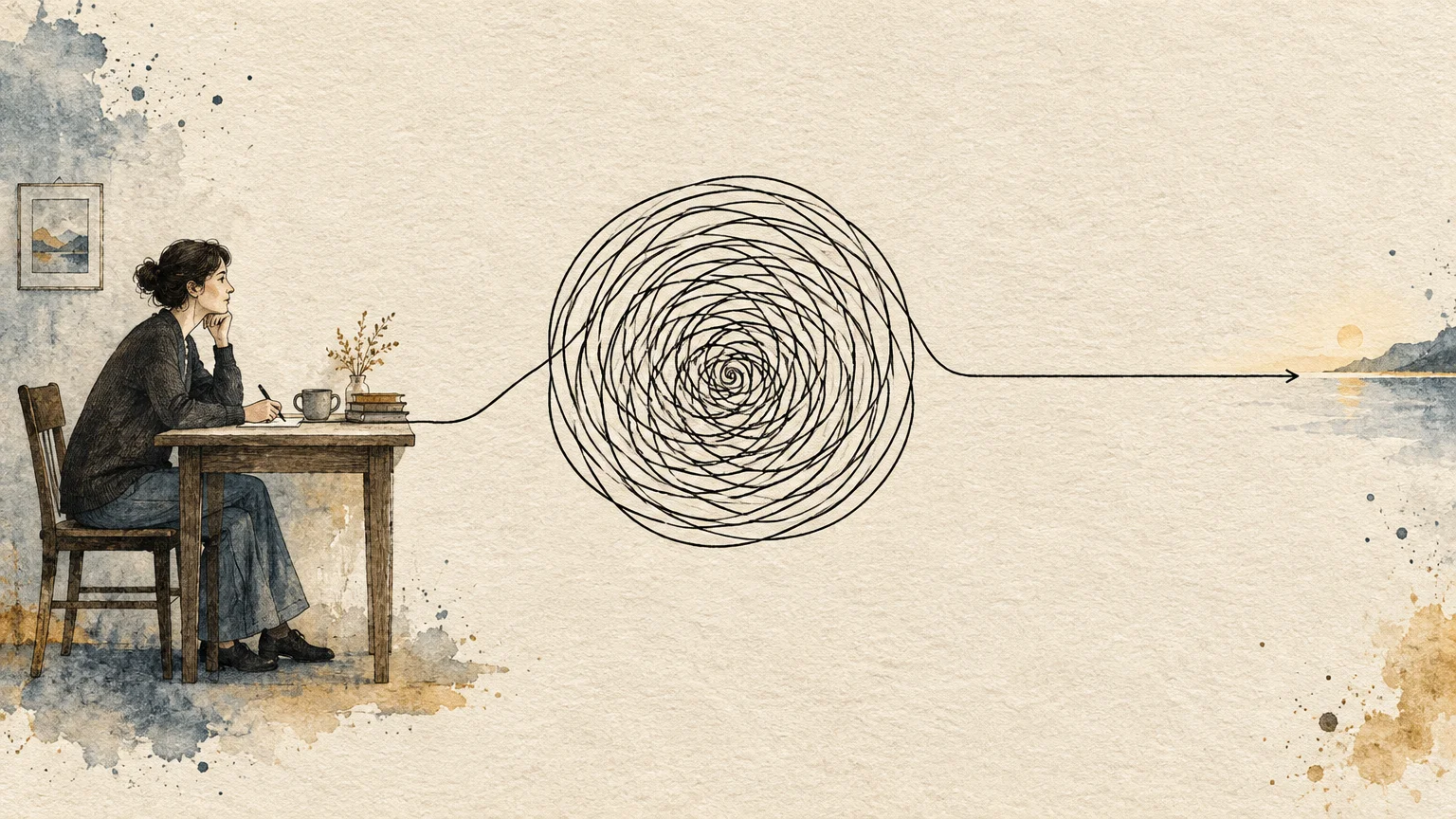
If you have ever lain awake at 2 a.m. rehashing a text you sent at dinner, you know overthinking does not feel like a choice.
It feels like being careful, even though the hundredth replay tells you nothing the first one did not.
Research is fairly clear: overthinking is repetitive thought, usually rumination about the past or worry about the future, and it eases with practiced skills rather than willpower. The skills are noticing the loop, swapping abstract “why” questions for concrete next steps, and tolerating uncertainty.
In this article
- Rumination is not the same as reflection
- Craving certainty keeps the mind circling
- Automatic thoughts that prop each other up
- Seven ways to interrupt an overthinking loop
- 1. Name the loop and the distortion
- 2. Put a time limit on deliberation
- 3. Sort solvable from unsolvable
- 4. Test the thought against the evidence
- 5. Write it down, then check your predictions
- 6. Change your physical state
- 7. Practice tolerating uncertainty on purpose
- Constant worry that may point to anxiety disorder
Rumination is not the same as reflection
Psychologists separate reflection from rumination. Reflection is goal-directed: you think something through so you can act, learn or let it go.
Rumination is repetitive and passive. You circle the same thoughts, often about what went wrong and why, without reaching a resolution and often without meaning to start.
Worry is its future-facing cousin, rehearsing worst-case versions of a job interview, a hard conversation or a medical result that has not happened. Both rumination and worry feel like problem-solving, but no new information enters the loop.
| Feature | Reflection (productive problem-solving) | Rumination (past-focused) | Worry (future-focused catastrophizing) |
|---|---|---|---|
| Typical trigger | A decision to make or a lesson to draw | A mistake, slight, loss or low mood | An uncertain event ahead |
| Typical question | “What can I do about this?” | “Why did this happen? Why am I like this?” | “What if it all goes wrong?” |
| Mental process | Concrete, moves toward an answer, then stops | Abstract, replays the same material with no endpoint | Jumps to worst cases and treats possible as likely |
| Actionable antidote | Set a deadline, decide and act | Ask for one concrete next step, or redirect attention | Separate solvable from unsolvable; practice sitting with not knowing |
The “why” versus “how” distinction matters. Research reviewed by Edward Watkins found that abstract, evaluative thinking about problems tends to be unhelpful, while concrete thinking about how events unfolded and what to do next is more constructive.
Studies following people over time have found that a habit of rumination predicts later depression and is tied to anxiety as well. That body of work is summarized in a review by Susan Nolen-Hoeksema and colleagues.
Replaying a stressful event can also keep the body’s stress response switched on long after the event itself is over.
Overthinking also differs from intrusive thoughts, the sudden, unwanted images or impulses that feel alien and distressing. Rumination usually sticks to real events in your life, while intrusive thoughts often arrive out of nowhere.
Craving certainty keeps the mind circling
Overthinking is usually the mind trying, clumsily, to protect you. A few drivers come up again and again, and most people recognize more than one.
A need for certainty is a measurable trait in its own right, called intolerance of uncertainty. People high in it keep working a problem, hoping one more pass will produce a guaranteed answer that most real situations do not contain.
Fear of the wrong choice often follows a decision that turned out badly. The brain overcorrects by demanding more analysis before the next one, and the more the fear of failure stings, the more urgent overthinking feels.
Perfectionism sets the bar at the one objectively correct decision. Most choices, such as which job to take or what to say in a hard conversation, have several reasonable answers, so the search never ends.
Anxiety does not always show up as a racing heart or restlessness. For many people it shows up as thoughts that will not stop moving, which is why it can feel like “just thinking” rather than something to manage.
Old survival habits can outlast their usefulness. A child who grew up with an unpredictable parent may have learned to scan and anticipate constantly, and that vigilance can keep running in adulthood after the threat is gone.
Automatic thoughts that prop each other up
Psychiatrist Aaron Beck, whose work in the 1960s laid the foundation for cognitive behavioral therapy (CBT), noticed that people’s reactions depended less on events than on how they interpreted them. He called these fast, believable interpretations “automatic thoughts.”
Beck described a cognitive triad common in depression: negative views of yourself, of the world and of the future. Each corner props up the others, which is why one critical thought can snowball.
Picture someone who believes “I’m not good at my job.” That belief makes an ambiguous email from a manager look like bad news, and the bad news makes the future look bleak: “Nothing I do will work out.”
The triad runs on recognizable thinking errors, often called cognitive distortions. A distortion you can name is easier to question than one that simply feels true.
- All-or-nothing thinking: one mistake means total failure.
- Overgeneralization: a single setback becomes “always” or “never.”
- Mental filtering: a mostly good day is remembered only for its one low point.
- Mind reading and fortune telling: assuming you know what others think, or how events will unfold, without evidence.
- Catastrophizing: treating the worst outcome as the likely one.
- Personalization: taking responsibility for events largely outside your control.
You do not have to tackle the whole triad at once. Loosening one corner, often the self-critical belief underneath catastrophic predictions, tends to weaken the rest.
Seven ways to interrupt an overthinking loop
These techniques draw on CBT, and several overlap with the CBT exercises you can practice at home. They work best as habits repeated over weeks, not one-off fixes.
1. Name the loop and the distortion
When you notice the third or fourth replay, say plainly, “I’m ruminating,” or name the distortion: “This is catastrophizing.” Labeling creates a small gap between you and the thought, and rumination depends on running unnoticed.
2. Put a time limit on deliberation
If a decision truly needs thought, give it a boundary: fifteen minutes, then decide. Open-ended thinking expands to fill the time available, while a deadline forces attention onto the information that actually matters.
3. Sort solvable from unsolvable
Ask whether there is one concrete action you can take now. If there is, take it, even a small one: send the clarifying text, make the call, write the first paragraph.
If the event already happened or depends on someone else’s choice, more thinking will not change it.
Switching from “Why did this happen?” to “What is the next step, if any?” is the concrete shift the research favors.
4. Test the thought against the evidence
Treat an automatic thought as a hypothesis rather than a fact. Writing it out in stages makes the gap between feeling and evidence visible.
Take a short message from a manager that reads “Can we talk tomorrow?” and work through it like this:
- Automatic thought: “I’m in trouble. I’m going to lose this job.”
- Distortions: fortune telling and catastrophizing.
- Evidence for: the message is short and gives no reason.
- Evidence against: recent feedback was positive, and quick check-ins are often scheduled this way.
- Balanced thought: “I don’t know what this is about. It could be routine, and I’ll find out tomorrow.”
The goal is accuracy, not forced positivity. Sometimes the balanced thought is more hopeful, and sometimes it simply admits the answer is not yet known.
5. Write it down, then check your predictions
Inside your head, the same three thoughts can cycle endlessly; on paper, the repetition becomes obvious. Five unedited minutes of journaling can make a silent loop visible.
It also helps to record specific worried predictions with a date, then check back. Over weeks, that log becomes personal evidence of how often the automatic forecasts were wrong.
6. Change your physical state
Overthinking is often fed by stillness: lying in bed, sitting at a desk, staring at a screen. A short walk, a change of room, stretching or washing dishes shifts the context the loop depends on.
7. Practice tolerating uncertainty on purpose
This is the slower fix that changes the pattern rather than a single episode. Each time you let a question stay open, telling yourself “I don’t know yet, and that’s acceptable for now,” you build tolerance for ambiguity.
It will feel uncomfortable at first and gets easier over months of small, repeated practice. The discomfort is part of the training, not a sign it is failing.
Constant worry that may point to anxiety disorder
Everyone replays a conversation now and then. It is worth raising with a doctor or therapist when the pattern is near-constant, disrupts sleep, work or relationships, or comes with persistent dread, physical tension or a sense that you cannot control it.
Excessive, hard-to-control worry on most days for at least six months is the core feature of generalized anxiety disorder.
Ruminating on failures alongside low mood or lost interest in things for two weeks or more can be a sign of depression.
Loops that come with a strong urge to check, perform rituals or seek reassurance to neutralize a thought fit a different pattern, covered in the guide to how OCD works. Its treatment differs from the approaches used for ordinary rumination.
A list of symptoms is not a diagnosis, and only an assessment can sort these apart. Therapists commonly use cognitive behavioral therapy, which works on individual thoughts and on the deeper beliefs behind them, often formed through early criticism or repeated setbacks.
Self-help techniques can ease everyday overthinking, but they are not a substitute for treatment when an anxiety disorder or depression is driving it. Rumination-focused CBT, a version built specifically for repetitive negative thinking, has shown promise in trials with people who have residual depression.