
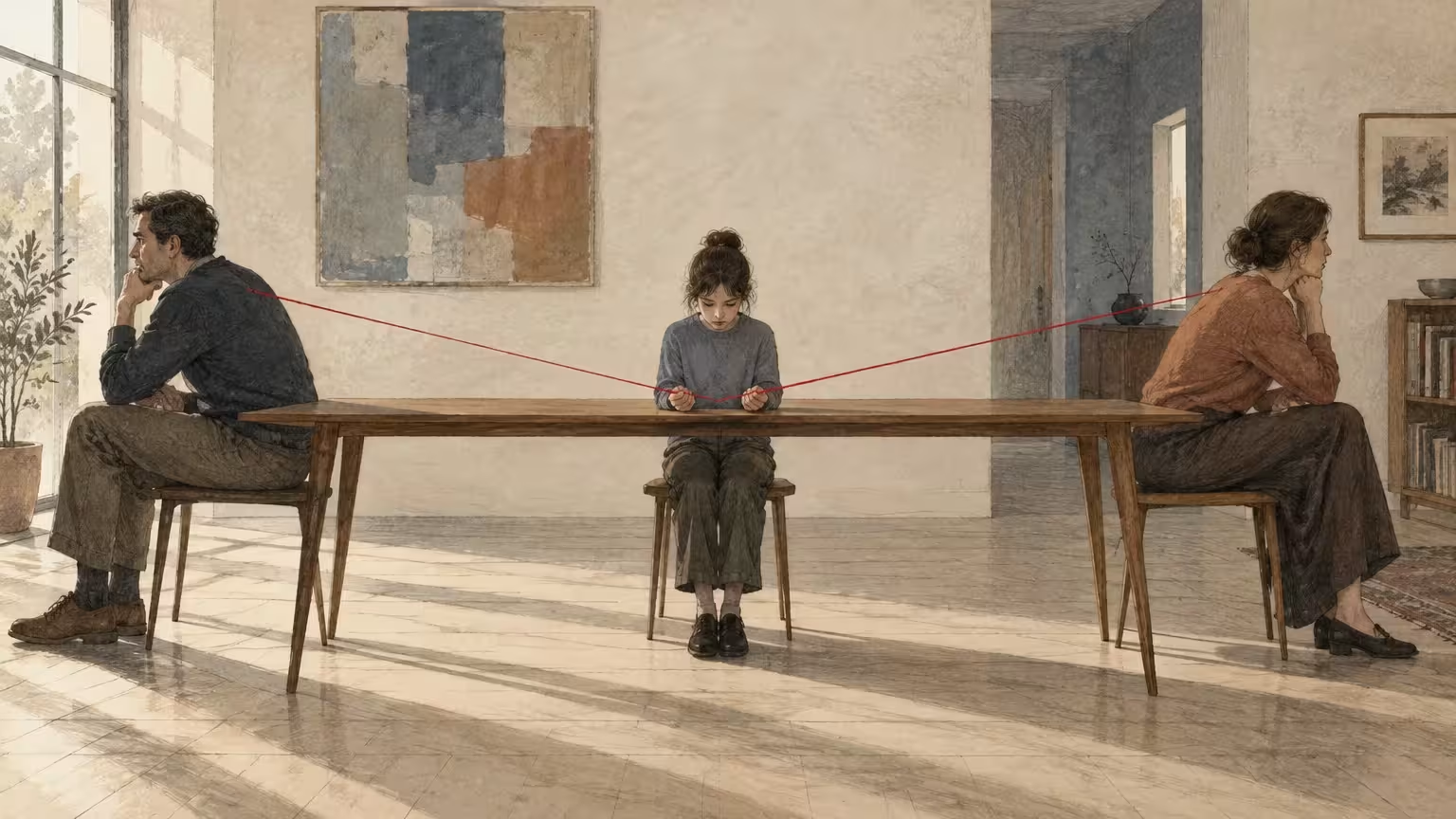
A mother asks her teenage son to find out whether his father is “actually” coming to the game this time. He passes the question on, softens the reply on the way back, and ends up holding a disagreement that was never his.
Family therapists call this triangulation: tension between two people is routed through a third person instead of being dealt with directly. It is common and usually unplanned, and it is far easier to spot from outside the triangle than from inside it.
In this article
Overt and covert triangles at home
Some triangles are overt. Parents criticize each other in front of a child, or ask outright whose side the child is on.
Covert triangles are quieter and often invisible to those involved. “Tell your father dinner’s ready” gradually becomes “tell your father I’m upset about the money,” or two relatives bond over complaints about a third instead of raising them with that person.
People caught in a triangle tend to recognize several of these signs:
- Messages between two relatives regularly pass through them.
- They feel responsible for calming or settling other people’s conflicts.
- They keep defending one family member against another.
- Two people with obvious tension between them almost never talk directly.
- They are told things “in confidence” that seem meant to reach someone else.
- Their role in family conflict feels fixed: always the peacemaker, the defender, or the difficult one.
The positions a family triangle creates
The messenger carries information, and often criticism, between two people who avoid speaking to each other. Children of separated or unhappy parents are the classic example.
The mediator or referee is asked to settle disagreements, pick a side, or act as an emotional buffer. When a child carries this kind of adult emotional responsibility, clinicians call it parentification.
The scapegoat becomes the shared problem. Two people who disagree unite around worry or anger about a third, often whoever said something inconvenient, and their own disagreement never gets discussed.
Some therapists describe this with the drama triangle of victim, rescuer and persecutor, a separate model from family systems theory that maps onto the same dynamic.
The roles can rotate, but blame and protection are always spread so that no two people face the real issue.
The confidant hears one person’s private grievances about another, often a parent confiding marriage problems to a child. It can feel like closeness, which is part of why it is hard to refuse.
Triangles also form between siblings, when a parent’s closeness to one child is used to manage tension with another. They can span generations too, with a grandparent pulled into a parent-child conflict, or adult children still caught in their parents’ marriage decades later.
The same structure turns up outside families, in couples who vent to a friend instead of each other, in friend groups, and at work.
Two-person tension seeks a third person
The concept comes from psychiatrist Murray Bowen, who developed family systems theory in the 1950s, partly through an NIMH research project with families of hospitalized patients. He argued that two-person relationships grow unstable under stress and that a triangle is the smallest stable relationship system.
The AAMFT family therapy glossary describes triangulation as bringing a third person into a two-person relationship to balance too much closeness, conflict or distance. Shifting tension onto someone else calms the original pair, at least for a while.
Bowen tied this to differentiation of self: the ability to stay emotionally connected to others while keeping one’s own thoughts and feelings steady under pressure.
Where differentiation is lower, family members absorb each other’s moods and find direct tension between two people hard to bear.
That is why triangulation is usually not deliberate manipulation. It tends to grow from anxiety and habits learned in the family, which makes it a pattern to interrupt rather than a flaw to pin on one person.
Bowen also saw some triangling as a normal part of family life. The concern is when triangles harden into the default way a family handles every conflict.
Bowen theory grew mainly out of clinical observation, and its broader claims have been tested less than many therapy models. Research on children exposed to parental conflict has, however, linked being drawn into that conflict with more anxiety, low mood and behavior problems.
The cost to the child caught in the middle
A triangle may ease things for two people, but the cost lands mostly on the third. A child repeatedly pulled into parental conflict is doing emotional work, including keeping the peace, that does not fit their age.
Because the original pair never has to face each other, the issue is managed rather than resolved. It tends to resurface in the same shape, with the same person in the middle.
Family systems therapists describe these roles as repeating across generations as largely unconscious scripts. A daughter caught between her parents may later find herself standing between her own partner and child.
A son who spent years as a parent’s emotional support may be drawn to partners who need looking after, recreating a familiar role without consciously choosing it.
Some adults who grew up managing other people’s moods also recognize themselves in descriptions of anxious attachment, a related idea from a different theory. In that pattern, insecurity in close relationships drives a strong need for reassurance.
Scripts for handing the conflict back
Leaving a triangle does not mean fixing the conflict between the other two people. It means handing it back to them, kindly and consistently.
| Position | What the pull sounds like | A script for stepping out |
|---|---|---|
| The messenger | “Can you tell your mom I’m not paying for that?” | “I’m not going to pass that on. You’ll get a clearer answer if you ask her yourself.” |
| The mediator or referee | “You’re the only one he listens to. Talk some sense into him.” | “I can see you’re both frustrated. I’m not the right person to settle this, and I don’t want to take sides.” |
| The scapegoat or persecutor | “Everything was fine until you brought that up.” | “If something I said upset you, tell me and we can talk about it. I don’t think I’m the reason you two are arguing.” |
| The confidant | “I can only tell you this, but your father has been impossible lately.” | “I love you, and I’m not the right person to hear this about Dad. Could you tell him, or talk it through with a counselor?” |
Guilt is common the first few times, and the same principles apply as with setting any boundary with people you love. A few habits help the scripts hold:
- Redirect every time. One relayed message restarts the pattern, so the same calm line, repeated, works better than a long explanation.
- Let the urgency pass. Stepping back from rescuing feels uncomfortable, especially after years in the role, but staying in it keeps the two real parties from ever talking.
- Look for the pattern, not a villain. Treating the triangle as a family habit makes it easier to step out without a fight about who is to blame.
- Check your own part. When tension arises with someone, notice whether the first move is to talk to them or to recruit someone else.
- Practice tolerating tension. Staying calm and connected while two relatives are at odds, without stepping in, is differentiation in action.
- Expect pushback. A family organized around the old pattern often resists at first, and holding a boundary consistently matters more than holding it perfectly.
Relatives turned against you on purpose
Most triangles grow out of anxiety, but some are used on purpose. Warning signs include one person deliberately turning relatives against another, spreading a version of events that isolates them, or using a child to monitor or punish a former partner.
When that sits alongside threats, monitoring, financial control or intimidation, it may be part of a wider pattern of emotional abuse. In that case, abuse support services are a safer starting point than joint family therapy.
A child may be carrying too much if they act as a parent’s main confidant, worry constantly about keeping the peace, or are asked to choose between parents. A pediatrician, school counselor or family therapist can assess what support would help.
For ordinary but entrenched triangles, especially ones spanning generations, family or couples therapy can help, because the whole system tends to pull one person back toward the old role.
Individual therapy is also useful for someone who wants to change their own position when relatives will not take part. Knowing what a first therapy session involves can make that step feel more manageable.