
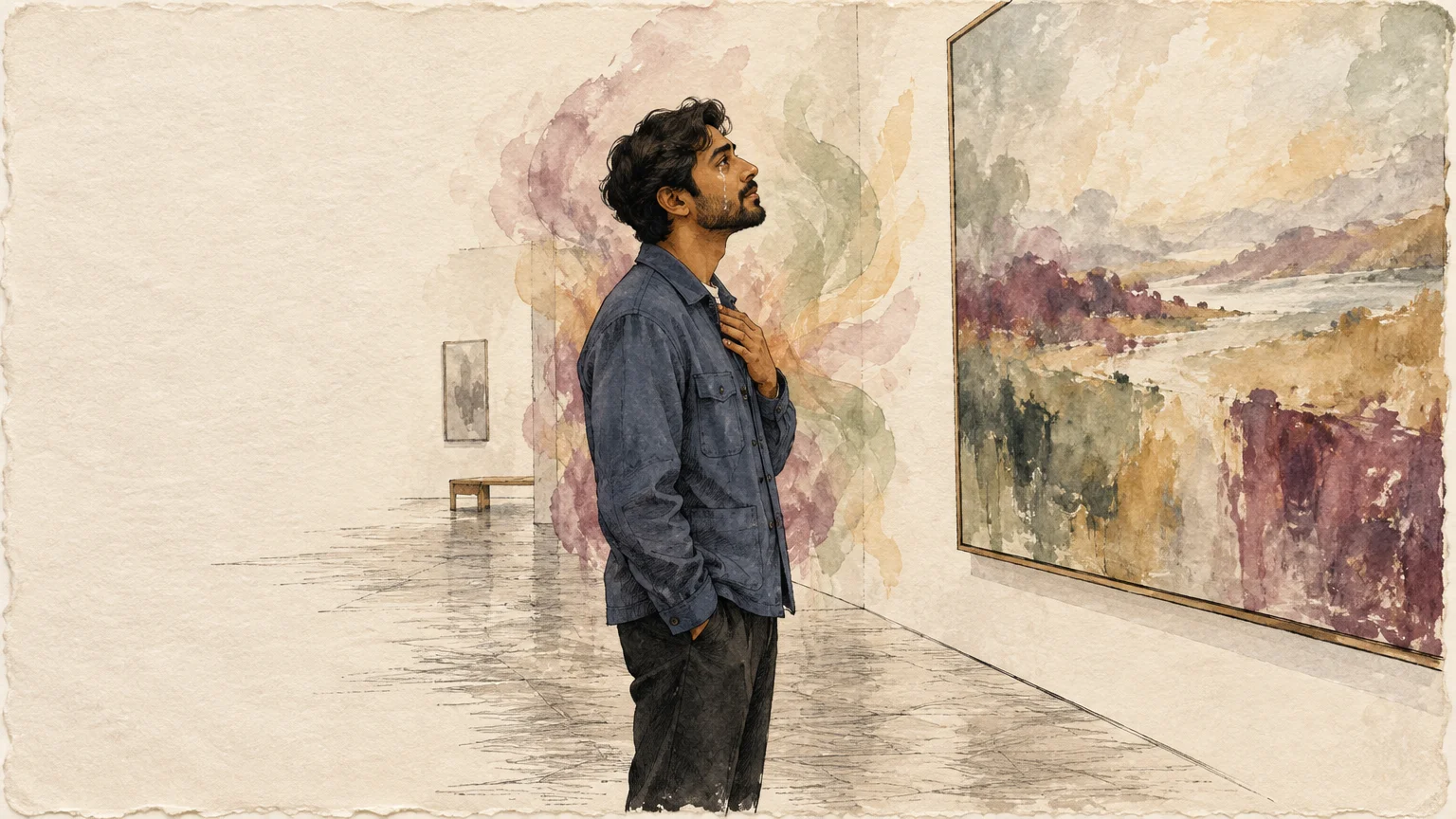
A dog-food commercial, a stranger’s kindness at a checkout, a manager saying “good job” in a meeting: for some people, any of these can bring tears within seconds, while others in the same room feel only a mild flicker.
Research suggests crying readily is mostly a stable individual difference, tied to temperament, empathy and upbringing, and pushed higher for a while by sleep loss, stress or hormonal shifts. A lifelong tendency is rarely a sign of illness; a recent, unexplained change sometimes is.
In this article
- Why humans cry emotional tears at all
- Stacked influences that lower the crying threshold
- A sensitive temperament
- Neuroticism and empathy
- Sleep loss, stress and exhaustion
- Hormonal shifts
- Upbringing, culture and gender
- Highly sensitive is not the same as introverted
- Living with tears that come quickly
- A new crying pattern deserves a doctor’s attention
Why humans cry emotional tears at all
As far as researchers know, humans are the only species that sheds tears for emotional reasons. Other animals produce tears to protect the eye, and so do people, but emotional crying appears to have developed mainly as a social signal.
Studies that digitally remove tears from photographs find that tearful faces are read as sadder and more in need of support. In experiments, visible tears also make observers more willing to offer help.
Crying researchers Asmir Gračanin, Lauren Bylsma and Ad Vingerhoets have also proposed that crying may be partly a self-soothing behavior, helping the body shift toward calm after the peak of distress. The evidence for that is still limited.
Whether crying leaves someone feeling better depends on context.
Large surveys of crying episodes suggest relief is more often reported when someone offered comfort, and less often when the person felt ashamed; the popular idea that tears flush stress hormones out of the body is not well supported.
Seen this way, tears that come easily are a signal working more readily than average, not a broken one.
Stacked influences that lower the crying threshold
Crying proneness is not one thing. Several separate influences can lower the threshold, and in one person they often stack.
A sensitive temperament
Psychologists Elaine and Arthur Aron named a trait called sensory processing sensitivity, popularly known as being a highly sensitive person. Their 1997 paper found it was partly separate from introversion and partly overlapped with emotionality, the tendency to react strongly to negative events.
Aron’s writing describes easy tears, including at music, beauty or kindness, as common among highly sensitive people. That link rests mainly on self-report questionnaires, so it shows how people describe themselves rather than a measured difference in crying.
Aron has long estimated the trait at 15 to 20 percent of people. A 2018 study she co-authored, using several samples, instead found low, medium and high groups, with roughly 30 percent in the highly sensitive group.
Either way, sensitivity looks like a continuum rather than a type. It is a temperament trait, not a diagnosis in DSM-5-TR or ICD-11, and nothing about it needs curing.
Neuroticism and empathy
People higher in neuroticism, the tendency to feel negative emotions intensely, react more strongly to stress and setbacks, and surveys of adults link the trait with crying more often.
Strong emotional empathy works differently. Seeing someone else cry or struggle produces a real emotional and bodily response, so tears can be triggered by other people’s feelings as much as one’s own.
Sleep loss, stress and exhaustion
Being short on sleep makes emotions harder to manage. The NHLBI lists trouble controlling emotions and coping with change among the effects of ongoing sleep deficiency.
Many people notice tears come faster at the end of a draining day. The popular explanation that self-control runs down like a fuel tank, known as ego depletion, failed a multi-lab replication, but fatigue and accumulated stress still make strong reactions harder to dampen.
Ongoing anxiety or low mood has a similar effect, shrinking the room for emotional regulation so that tears arrive with less obvious provocation.
Hormonal shifts
Changes in reproductive hormones around periods, pregnancy, the weeks after birth and perimenopause can make tears come more easily for a time, without any change in personality.
After childbirth, weepiness in the first two weeks, often called the baby blues, is common. Low mood that lasts longer or deepens may be postpartum depression, which is treatable.
Upbringing, culture and gender
Children whose tears were met with comfort often keep easier access to crying as adults. Those mocked or punished for crying may learn to hold tears back, though some swing the other way.
Across many countries, women report crying more often than men on average. Researchers attribute much of that gap to social norms about who is allowed to cry, alongside possible biological factors such as hormones.
Highly sensitive is not the same as introverted
Easy crying often sends people toward online quizzes and labels that overlap but mean different things. The comparison below sets out the three most often confused.
| Feature | Sensory processing sensitivity (highly sensitive person) | Introversion | Sensory processing disorder |
|---|---|---|---|
| What it is | A temperament trait described by Elaine Aron | A personality trait, the low end of the extraversion dimension | A proposed label for difficulty processing and responding to sensory input; not in DSM-5-TR or ICD-11 |
| Core features | Deep processing, being easily overstimulated, strong emotional reactions, noticing subtle details | Preferring quieter, smaller social settings and recharging alone | Over- or under-reacting to sound, touch, textures or light, or seeking intense sensation, enough to disrupt daily routines |
| Link to crying | Easy tears, including at beauty or kindness, are commonly reported | No particular link; it concerns social energy, not emotional intensity | Distress or meltdowns when sensory input becomes overwhelming, mostly described in children |
| How it is identified | Self-report questionnaires | Personality questionnaires | Assessment usually by an occupational therapist, often alongside checks for autism, ADHD or anxiety |
None of the three is a mental health diagnosis on its own, and they can coexist with each other or with anxiety, ADHD or autism. A highly sensitive person can be outgoing, and an introvert can rarely cry.
Sensory processing disorder is a term used mainly by occupational therapists working with children. Because sensory problems so often travel with other conditions, clinicians usually look for autism, ADHD or anxiety behind sensory issues before settling on that label.
Intense anger or disgust at specific everyday sounds, such as chewing or breathing, is a different pattern again, usually called misophonia.
Living with tears that come quickly
If crying easily is a lifelong pattern and life is otherwise going well, the aim is usually to make it less disruptive, not to stop it. Crying is generally considered a healthy response rather than something to suppress.
Name what is underneath. Tears can come from sadness, but also from frustration, relief, being moved or plain overload.
Identifying which one points to the right response, whether that is a break, a conversation or a quieter room.
Slow the body down. Slow breathing with longer exhales can take the edge off the physical surge that comes before tears.
Several breathing techniques are simple enough to use discreetly in a meeting.
Step away without apology. A short break to let the wave pass is a practical choice, not a failure.
A prepared phrase such as “Give me a minute, this matters to me” can make returning to the conversation easier.
Look at the setting. If tears keep arriving in one place, such as a particular relationship or job, the setting may be doing as much work as the temperament.
Reducing that load can cut crying even when sensitivity stays the same.
Fix sleep first. Because sleep loss lowers the threshold so reliably, a run of short nights is worth addressing before concluding that something deeper has changed.
Drop the shame. For many people the embarrassment is harder than the tears themselves.
Treating easy crying as part of how they process the world, rather than a weakness, can make each episode less of an event.
A sensitive temperament tends to be stable, so the realistic goal is fewer unwanted episodes, not a different personality.
When emotions feel hard to manage in general, therapies such as CBT and DBT teach regulation skills in a structured way that self-help alone does not replace.
A new crying pattern deserves a doctor’s attention
The most useful question is whether this is new. A lifelong tendency that has not changed is usually temperament; a clear shift over weeks or months deserves attention.
Crying most days alongside low mood, lost interest, or changes in sleep and appetite for two weeks or more can be part of depression, which often shows up in ways beyond sadness.
Frequent tears with constant worry, tension or dread may point to an anxiety problem rather than temperament.
Some people swing between crying spells and stretches of feeling emotionally numb, a pattern worth describing to a clinician in exactly those words.
Sudden, uncontrollable bouts of crying or laughing that do not match how a person actually feels can be pseudobulbar affect. This neurological symptom occurs after stroke or brain injury and with conditions such as multiple sclerosis and ALS, and it needs a medical assessment.
New medications, thyroid problems and other physical health issues can also affect mood, which is one reason a doctor’s appointment is a sensible first step.
Bringing a few notes helps: when the change started, what tends to trigger tears, how sleep has been and what else has shifted. A professional can then tell a lifelong sensitivity apart from a recent, treatable change.